
Where to Find the Best Online Casino Reviews

Image by Gerd Altmann from Pixabay 

If you are a gambler in Canada the world really is your oyster, there is just so much choice. In fact, quite honestly, sometimes it can be almost impossible to decide. Are you looking for the latest releases, the biggest jackpots, the fastest payouts or maybe a particular game title?  Then there are all those bonuses to consider. All online casinos are vying for your attention, using promotions to attract you to their sites. Canadians have really embraced e-commerce in all its forms, and nowhere more so than in the gambling market. 

So now that there is so much choice, another industry has sprung up to try and help you find your perfect casino. Think about it like a matchmaking service, but rather than searching for a life partner, online review sites are trying to find you the perfect place to play. They also differ from professional matchmakers who can charge extortionate fees for their services in that great review sites are independent, expert advice is free, and they are not necessarily expecting you to build a lasting relationship with the online casino! While they are happy to tell you about the best loyalty bonuses, they do often recommend shopping around! 

The latest dilemma is not just how to find the best online casinos in Canada, but also how to find the best online review sites! It can be hard to distinguish between those who have the players’ best interests at heart and those who are just there to make a quick buck. It can be tempting to listen to what your favourite social media influencer or Twitch streamer is raving about, but are they offering objective advice or are they just a paid extension of a brand’s marketing and PR department? 

We decided to have a bit of a dig behind the scenes to find out where you can find decent, honest, independent reviews when looking to find the best casino online. If you are looking for safe Canadian online casinos, it is important to verify them through trusted comparison sites. Among the most well-established options are: 

  • Casino.ca
  • Casino.org
  • OddsChecker
  • AskGamblers  

While there are many decent review sites out there, Casino.ca stood out for several reasons (which we will go into in more detail in a minute). However, its extensive vetting process, detailed operator reviews, and long-standing reputation for player protection meant it pipped the others to the top slot. So, when you are out and about in your RV, we suggest you take a look here. 

So, let’s take a deeper dive into the best-rated site for casino reviews. 

Casino.ca 

In the top slot is this pan-Canada review site that really understands the market and what players want. The site proudly invites players to find the best money online casinos in Canada based on their team’s “100 years of combined experience”. They claim to have reviewed 140+ regulated casinos to identify sites that players can trust. Their thorough process checks for licensing from top regulators, including iGaming Ontario and the Kahnawake Gaming Commission.  

They are not a static reviewer, and they continuously monitor the Canadian market for new casino sites and retest existing brands to see how their offerings are improving or declining. This site takes the guesswork out of choosing a casino with a thorough evaluation process. 

Every Canadian online casino is reviewed, rated and ranked using the same strict framework. Then, key casino features carry different weights when compiling the reviews. 

  • Security and fairness = 20%
  • Bonuses and promotions = 15%
  • Games and software = 15%
  • Localization = 10%
  • Mobile friendliness = 10%
  • Customer service = 15%
  • Banking options and payout speed = 15% 

We were particularly impressed with the transparency with which Casino.ca approached the review process, and here are some more details to explain, 

Security and fairness are their top priorities, and if a site does not meet their strict standards, it will not make their list, no matter how many games and bonuses it offers. They do not just take the site’s word for it but verify that the casinos hold the right licenses to ensure that player protection policies and fair enforcement are in place. They also check for SSL encryption technology to guarantee personal and financial data are protected at all times. 

Bonuses might be tempting, but not all are as attractive as they look. The team goes beyond the dazzling headlines to determine the true value of the offers and identify the restrictions.  

Games and software are what you came for, and they check for a good range of slots, table games and live dealer options. They also look for the names of developers, and high-scoring casinos will feature titles from excellent partners like: 

  • Microgaming
  • Pragmatic Play
  • NetEnt 

These developers are known for fair play, innovation, big-win potential, and thrilling gameplay – the perfect recipe! 

Mobile compatibility is a must because almost everyone plays on their phones these days. 

Casinos that cater specifically to the Canadian market are a priority so that players can make deposits and withdrawals in Canadian dollars and get a bilingual user experience. Localization matters because different jurisdictions have different laws and licensing authorities. 

Banking options and payout speed are essential factors when playing online. Casino.ca also check for low deposit and withdrawal limits so you can keep control of your bankroll. 

Customer service is essential because you never know when you might need help, whatever time of day or night. 

So maybe now you can see why this is the site to find the best reviews – they have covered every base to bring you a three-sixty view. In addition, they have great free games and tournament options. It really is like a one-stop shop! 

The Best of the Rest 

We rated Casino.org highly, too, and it came in a close second. Like Casino.ca, they offer localized, countrywide coverage and use a 25-step review process that they have honed for over three decades. They also have great guides and gaming tips, together with an up-to-date news section. We particularly loved their blog that has ‘insights from the experts’ and tips on winning on scratch cards and physical slots. They also have good tips on sports betting. An all-round site with great intel. 

OddsChecker is great for checking the odds but is less hot on reviews. 

AskGamblers is a great source for reliable online gambling information and has a unique complaints system to help resolve any issues.  

Remember, whichever site you choose, to check out their responsible gambling pages and never gamble more than you can afford to lose. 
Rolling the Dice on the Road: How Travelers Are Rediscovering America’s Casino Destinations

“How about we visit a casino?” – that’s now the standard suggestion when travelers are looking to pack entertainment, fine hospitality, and unique experiences all into the same vacation. Casino resorts today offer more than just card tables and roulette wheels. In fact, they’ve become all-in-one destinations that offer accommodation, live entertainment, wellness facilities, and more.

The attraction to casino resorts is supported by a better national infrastructure, domestic tourism, and changing travel preferences. These have encouraged people to make casino resorts part of their road trip or make them their destination outright. Ultimately, casino resorts are destinations for a broader customer base, not just gamblers.

This article will explore why travelers are rediscovering casino destinations in the USA and what is behind this fresh interest in them.

The evolution of casino destinations

Casinos have transformed. No longer do they just consist of gaming floors; they’re now multipurpose travel destinations. If you’re planning to visit a casino resort today, there’s a chance you’ll be able to:

  • Book a stay in luxury hotel accommodation
  • Dine or drink at a variety of catering facilities
  • See a live show, which could be drama, comedy, a concert, or other live entertainment
  • Enjoy family-friendly facilities

Entertainment beyond the casino floor

Gambling may provide excitement, but the wide range of leisure options besides gambling has people flocking to casinos.

Visitors to casinos can steer clear of the gambling floors altogether and still make an occasion of their visit. They can:

  • Attend concerts and other live events
  • Enjoy fine dining or more casual eats without having to leave the site
  • Spa and wellness facilities, such as massage, yoga classes, fitness centers, and holistic treatments
  • Outdoor facilities and pursuits, such as swimming pools and golf course
  •  Venues for sporting events, and areas to follow the action on screen.

Today, visitors are seeking experiences, high-end ones in particular. Casinos have understood this, which is why they promote experiences as much as their gambling services, if not even more.

Pennsylvania is a strong example of why casino tourism fits so naturally into road-trip culture. The state has a wide spread of casino destinations across urban, suburban, racetrack, and resort settings, from Philadelphia and Pittsburgh to the Poconos, Bethlehem, Erie, and other regional stops. Gambling is on the rise in the state, if you explore PA casino options, you’ll notice that many online operators offer 1,000+ games, according to Casino.org. This growing online competition has encouraged physical venues to focus even more on the full visitor experience. For travelers, that means Pennsylvania’s casinos can be worked into a wider itinerary rather than treated as the sole reason for a trip. Many offer dining, hotels, live entertainment, sports viewing, and event spaces, making them useful places to stop, stay, or add a memorable evening to a longer journey.

Why road trips and casino tourism are growing

So, casino resorts are experiencing renewed popularity, but what’s driving this renewed interest?

  • The getaway culture: people are taking short breaks to escape from the challenges of everyday life at home.
  • Driving is convenient, flexible, and, as well as the freedom of being out on the road, creates more access to destinations.
  • Domestic leisure travel is growing in the US, but as costs increase, Americans may take shorter trips or lower-cost ones.
  • Casino resorts have become regional entertainment hubs and not just gambling destinations. People seeking not just gambling but other experiences are visiting them.

The fact that casinos don’t just cater for gambling enthusiasts is allowing them to fit within broader travel itineraries more easily. Travelers may incorporate seeing a show, partaking in some fine dining, or even take timeouts in wellness facilities into their travel plans.

Technology enhancing the travel experience

Of course, casinos wouldn’t experience some of the success they do without the help of different digital tools. These include:

  • Mobile booking technology to book a stay, a restaurant table, or tickets to see a show
  • Digital loyalty programs to retain customers and drive further engagement
  • Contactless payments
  • Personalized travel offers.

Technology is helping to create more seamless experiences. They provide guests who want to conduct their business on their phones with convenience. Interactions aren’t only transactional, but they also become more personalized.

The future of casino tourism in America

As casino tourism grows in America, the industry is seeing certain emerging trends, or can expect them to emerge, such as:

  • Integrated casino resorts
  • Casino destinations outside of Las Vegas, including Atlantic City, New Jersey, and in wider North America, Ontario, Canada
  • Digital resources shaping travel planning by offering comprehensive guides, insider tips, and real-time updates to help tourists make informed decisions
  • Greater personalization of travel experiences
  • More smart technology at casinos, such as contactless check-ins
  • Continuous investment in regional casino destinations.

Hospitality, gaming, and tourism are all beginning to converge, and integrated casino resorts are becoming highly popular. As this popularity continues, they’re sure to take on even greater importance in the tourism industry.

America’s casino resorts have become entertainment and hospitality hubs, not just places to gamble. Their convenience and diverse amenities and attractions appeal to a wider audience, and technology and changing habits in tourism are triggering renewed casino growth. So much growth that they’re becoming an important part of the wider tourism landscape. Continued investment in hospitality, entertainment, and digital innovation will shape the progression of the US travel industry.

When Vegas Costs Steer Play to the Rig

Somewhere outside Boulder City, a couple sits at the dinette of their fifth-wheel, calculator app glowing and a Las Vegas trip spreadsheet open. The numbers keep climbing. A midweek room on the Strip that once ran a modest rate now carries a resort fee stacked on top, valet parking has a charge again, and the buffet that used to be a bargain feels more like a splurge. For RV travelers who love a little casino action, the math has quietly turned a spontaneous Vegas run into a carefully weighed decision. The lights still beckon, but the budget does the talking.

That squeeze is exactly why so many road-trippers are rethinking where their entertainment happens, and increasingly the answer is a screen inside the rig. Anyone weighing options tends to lean on rankings of the best online casinos built for US players, where offshore operators get compared on welcome bonuses, game libraries, and how payouts actually work. Those roundups exist because travelers want to know which sites treat US-based players fairly, how the games stack up against a real floor, and what the terms genuinely mean before committing a dollar. For someone parked far from the neon, that kind of side-by-side comparison answers the practical question at the heart of a tightening trip budget: where does the fun go when the drive to the Strip stops making financial sense?

The New Math of a Vegas Weekend

The classic Vegas RV plan used to be simple. Point the coach toward the desert, snag an overnight lot near a casino, and let the trip pay for itself through comped meals and floor time. That arithmetic has shifted. Fuel to haul a heavy rig across state lines adds up fast, and the incidental costs waiting at the destination pile on before the first pull of a slot handle.

Travelers running the numbers often find the entertainment portion of the trip is the smallest line item, dwarfed by lodging, fees, and the cost of simply getting there. When the goal is a few hours of blackjack or a spin on a favorite slot theme, driving four hundred miles to pay resort fees starts to feel like an expensive way to do something the rig can already handle. The love of the game hasn’t faded. The logistics around it have just gotten pricier.

Why the Rig Becomes the Casino Floor

Back at that dinette outside Boulder City, the couple isn’t giving up on gaming. They’re relocating it. A tablet propped against the windshield, a decent signal bar, and a quiet evening turn the rig into a personal casino floor. Online slots carry the same big-name themes travelers recognize from the aisles of a physical property. Live dealer blackjack and roulette stream real croupiers in real time, so the social pulse of the table isn’t lost to the desert quiet.

The appeal isn’t just cost. It’s continuity. A boondocker tucked into a remote site doesn’t have to abandon the hobby just because the nearest floor is hours away. The games travel with the rig. That flexibility matters most when the day’s plan already revolves around a great view rather than a great buffet.

Where the Boondockers Actually Park

Skipping the Strip opens up campsites that a Vegas-centered trip would never touch. Instead of a crowded overnight lot, travelers stretch out across the wide-open desert. The Bureau of Land Management offers dispersed camping on public lands throughout the Southwest, where a rig can sit for days under enormous skies with no resort fee in sight.

For those who still want to stay within striking distance of the Vegas glow without paying Vegas prices, the surrounding public lands deliver options with real character. The trade is a longer drive to any physical floor in exchange for solitude, dark skies, and a budget that finally balances. Evenings that once meant a casino carpet now mean a folding chair, a cold drink, and a screen glowing with the games the traveler actually came to play.

Signal, Scenery, and Smart Vetting

Any traveler leaning on the rig for evening entertainment learns quickly that a reliable connection is the real currency. Sites near the water tend to hold signal well, which is part of why so many head for the camping at Lake Mead area, close enough to civilization to keep the bars up while still trading pavement for shoreline.

The vetting habit matters just as much as the connection. Experienced players read the fine print on bonus terms, check how quickly a site processes cashouts, and confirm the game library actually includes the titles they enjoy. It’s the same instinct a careful traveler brings to choosing a campsite: know what you’re getting into before you commit. A little homework up front keeps a quiet desert night from turning into a frustrating one.

Closing the Loop on the Trip Budget

Not every stop drifts far from the map. Some travelers split the difference, parking at the scenic Red Rock Canyon campground just west of the city, where morning hikes among the sandstone give way to relaxed evenings in the rig.

That’s the loop finally closing for the couple outside Boulder City. The spreadsheet that once threatened to cancel the whole trip now tells a cheerier story. The drive got shorter, the fees vanished, and the scenery improved. The games they loved never left, they just moved home. The Strip will always shine, but the smartest RV travelers have discovered that the best seat in the house is the one they towed there themselves.

How RV Travelers Check a Site’s License First

Ask a seasoned RV traveler what they do before spinning a single reel on a new site, and the answer rarely involves the games at all. It starts with the paperwork. For those who spend evenings parked somewhere quiet with a laptop and a thermos of coffee, the licensing details behind an online casino california matter far more than the flashy welcome bonus on the homepage. Affiliate review guides built for California players spend a good chunk of their coverage on exactly this: who holds the license, what payment methods are supported, how quickly winnings clear, and whether the mobile experience holds up on a weak signal. That kind of groundwork is why travelers lean on those roundups before they ever put money down.

Why Licensing Comes First on the Road

There’s a reason RVers treat licensing like they treat a campground’s water hookup: skip the check and the whole night can go sideways. When someone’s home address changes every few days, they don’t have the luxury of walking into a physical location to sort out a problem. Everything happens on a screen, often from a spot where the nearest town is forty minutes away.

A verifiable license tells a traveler that a site answers to an outside authority, follows rules about handling deposits, and can’t simply vanish with a balance. For the boondocking crowd parked on BLM land outside Quartzsite, that assurance is the difference between relaxing entertainment and a headache with no easy fix. So the license number gets checked, the issuing body gets a quick search, and only then do the games get a look.

Reading the Fine Print Before the Fun

The habit looks a lot like planning a route. Experienced travelers cross-reference. They find the license reference listed at the bottom of a site, then confirm it against an independent source rather than taking the badge at face value. A logo alone means nothing; anyone can paste an image onto a webpage.

Review guides speed this up considerably. Instead of digging through fine print on a spotty connection, a traveler can scan a summary that already lists the licensing status, the accepted payment methods, and typical cash-out timing. That’s the same instinct that leads someone researching a stay to read up on Camping Outside of the Park before committing to a spot. Knowing the ground rules ahead of time saves the aggravation of discovering them the hard way.

Payment Methods and the Connection Question

Licensing is the first gate, but it isn’t the only one. How money moves in and out ranks close behind, especially for travelers who rely on crypto cashouts when they’re far from a bank branch. A properly licensed site tends to be transparent about which deposit and withdrawal options it supports, and that transparency is itself a signal worth noting.

Cash-out timing plays into the same picture. Someone rolling out of a campsite at dawn doesn’t want a withdrawal stuck in limbo for a week. Review roundups often flag how long a given site takes to release funds, and travelers weigh that against their own schedule. A site that clears winnings promptly and lists clear payment options earns a spot on the shortlist. One that stays vague about either usually gets skipped, no matter how generous the promotions look.

Mobile Play Meets the Great Outdoors

For the RV set, the phone is the whole show. Laptops come out at night, but the day belongs to whatever fits in a pocket during a hike or a slow afternoon in a folding chair. That makes mobile compatibility a genuine screening factor, not an afterthought.

A well-run site loads cleanly on a single bar of signal and doesn’t drain a battery that’s already stretched thin between the fridge and the water pump. Travelers exploring California Recreation Activities across the desert and coast know their connection can drop without warning, so they favor sites that handle interruptions gracefully. Licensing details still lead the vetting, but a smooth mobile experience keeps a site in rotation once the trust is established. A gorgeous desktop site that stutters on a phone doesn’t do a boondocker much good.

Turning the Checklist Into a Routine

Over time, all of this becomes second nature. The same traveler who runs through a pre-drive checklist — tire pressure, awning latched, steps up — develops a parallel routine for evening entertainment. License confirmed. Payment options understood. Cash-out timing acceptable. Mobile experience tested. Only then does the fun start.

That routine tends to hold up whether someone’s parked near a bustling stretch of the coast or tucked into a remote corner near Joshua Tree National Park, where the stars are the main event and the Wi-Fi is a rumor. The scenery changes constantly; the vetting steps don’t. That consistency is exactly what makes casual gaming feel dependable rather than risky.

Where the Homework Pays Off

The payoff for all this caution is simple: peace of mind. A traveler who has confirmed a site’s licensing, understood its payment methods, checked its cash-out timing, and tested it on a phone can settle into an evening without second-guessing every click. The welcome bonus becomes a nice extra rather than the deciding factor.

Review guides built for California players fold all of these considerations into one place, which is why so many RVers reach for them before committing. In a lifestyle defined by changing scenery and unpredictable connections, having a trusted starting point turns a potential gamble into a genuinely relaxing way to close out the day.

The Vegas Budget Gap Every Road-Tripper Faces

Every long haul toward Las Vegas eventually runs into the same math. The couple at the dinette of a Class C, somewhere past Barstow, has the fuel log open on one screen and a resort rate on the other. The Strip is still hours away, and the numbers keep climbing — parking fees, a two-night minimum, dinner, and the buffet that isn’t cheap anymore. That gap between where the rig is now and where the neon starts is the real budget question. It’s the stretch where a road-tripper wants a little casino-style fun without lighting the vacation fund on fire before the trip even begins.

That’s exactly where the free-to-play model earns its keep. A sweepstakes casino works on virtual credits rather than a real-money buy-in, and those credits can convert into real cash prizes or gift cards through a redemption process. For a traveler still miles from the Strip, that matters: it’s a legal, no-cost way to spin familiar-looking slots or play a hand of cards from the passenger seat, with legality that varies state to state. Directories that rank the top social gaming sites break down which ones are available where, what welcome bonuses they hand out, and how the prize redemption actually works — the kind of homework that saves a road-tripper from guessing while parked at a rest stop.

Why the Miles Between Stops Cost the Most

Ask anyone who plans Vegas trips around an RV and they’ll tell you the drive is where budgets quietly leak. There’s the temptation to stop at every small casino off Interstate 15, dropping twenty bucks here and forty there, all of it adding up long before the Welcome to Las Vegas sign. Those detours feel harmless in the moment, but they’re the exact dollars a smart traveler would rather save for a real night on the Strip.

The appeal of a free-to-play option during those miles is that it fills the same itch without touching the trip fund. Boondocking at a BLM site outside Primm, waiting out afternoon heat, a person can pull up a social gaming site and get the reels spinning without a single dollar at risk. The entertainment is real, the stakes are optional, and the vacation budget stays intact for the destination that actually inspired the trip.

How the Free-to-Play Model Actually Works

The mechanics trip people up at first, mostly because the whole thing borrows language from an older idea. A traditional promotional prize drawing lets people enter and win without paying to play — think of the mail-in contests that have been around for generations. Social gaming sites run on that same legal foundation. Players get one type of virtual currency purely for fun and a second type that can be redeemed for prizes, and there’s always a no-purchase way to collect that second kind.

For a road-tripper, that structure lands differently than a real-money account. Nobody has to wire a deposit from a spotty campground connection or worry about clawing money back later. The credits arrive through daily bonuses, mail-in requests, or promotional drops, and the games themselves — slots, poker, blackjack lookalikes — feel exactly like what waits on the Vegas floor. The difference is that the entry ticket costs nothing, which is precisely the point when the fuel gauge is the more pressing concern.

Keeping the Trip Fund Aimed at the Strip

The whole guiding idea here is simple: protect the money meant for the destination. A well-planned Vegas trip has a fixed pot for the tables, the shows, and maybe a splurge dinner. Everything spent before arrival is a subtraction from that pot. Free-to-play credits let a traveler stay entertained through the long, flat stretches without ever dipping in.

There’s a genuine economic logic underneath it, too. Researchers examining the future of prize gaming have looked at how free-entry models deliver real value to players without the financial exposure of a wager, which is why the format keeps growing. For someone whose home has wheels and whose entertainment budget flexes with fuel prices, that value proposition is easy to appreciate. The fun is decoupled from the risk, and the risk is where budgets usually break.

Fitting It Into the Rhythm of the Road

RV travelers already stack their leisure carefully. They time overnight lots near casinos that welcome rigs, they layer loyalty perks from one stop to the next, and they think hard about where a dollar goes. Adding a free-to-play option to that rhythm is a natural fit. It slots into the downtime — the hour after setup, the wait for the sun to drop, the evening when the nearest gaming floor is a four-hour haul in the wrong direction.

State legality is the one detail worth checking before leaning on it. The free-to-play model is available across most of the country, but a handful of states carve out exceptions, and the redemption rules shift with those lines. A traveler crossing from Nevada into a neighboring state may find the prize side of an account behaves differently, so it pays to know the map. Good directories keep that state-by-state picture current, which spares the road-tripper from learning the hard way at a campground picnic table.

By the time the rig finally rolls onto the Strip, the traveler who used those free credits through the drive arrives with the trip fund untouched and the appetite for real play fully intact. The budget question that loomed back near Barstow answers itself: the entertainment happened all along the route, and it never cost the vacation a thing.

Why Boondockers Chase Payouts Miles From the Floor

Ask any long-haul RV traveler what changes most when the nearest gaming floor is a four-hour drive away, and the answer usually isn’t the scenery. It’s the money. Out on a quiet stretch of BLM land near Quartzsite, or tucked into a dispersed site outside Moab, the whole rhythm of a casual evening shifts. There’s no cashier’s cage, no player’s club desk, no line at the ATM. Yet plenty of boondockers still want a little light entertainment after the sun drops behind the mesa — and, just as importantly, they want a clean way to move winnings without hauling those winnings anywhere at all. That single need, quiet and location-independent, is where crypto quietly enters the picture.

For travelers who already keep a portion of their spending money in digital coins, the appeal of moving winnings straight back into a wallet is easy to understand. Before settling on where to spend an evening, many of them lean on review sites that vet crypto-friendly gaming destinations, comparing which ones actually pay in Bitcoin and which ones just say they do. A resource that lets someone research where to play with bitcoin deposits does the heavy lifting of sorting the reliable spots from the dodgy ones, flagging coin support, cashout speeds, and the overall reputation of each destination. For a boondocker with one flickering bar of signal, that kind of pre-screening matters more than it would for someone standing in a lobby, because there’s no staff to ask and no counter to walk up to. The review becomes the front desk.

Why the Cashout Matters More Off-Grid

On a physical floor, cashing out is almost an afterthought. You feed a ticket into a machine or hand it to a teller and walk away with bills. Off-grid, none of that exists. A traveler parked in the high desert can’t exactly drive two hours to redeem a slip. So the question becomes how winnings actually leave a digital account and land somewhere useful.

Crypto answers that question neatly. A payout in Bitcoin or a stablecoin lands in the same wallet that holds gas money and grocery money, no bank branch required. That’s the whole draw for people whose home address is a set of wheels. Winnings don’t need to be tied to a fixed mailing location or a local branch that might be states behind them by the time a check would clear.

The Signal Problem, and Working Around It

Boondocking and bandwidth have always been an uneasy pair. Some travelers swear by a cellular booster and a rooftop antenna; others plan their overnight stops around where the maps promise a usable signal. The reason it matters here is simple: a crypto transaction needs only a brief, stable connection to confirm, far less than streaming a movie or hopping on a video call.

That lightweight footprint is part of why coin-based play suits road life. A wallet transfer is a small burst of data, then done. It’s the same efficiency researchers keep exploring in adjacent fields — the U.S. Postal Service has even studied possibilities for blockchain use in delivery and identity systems, precisely because the underlying tech moves value and verification without a heavy central hub. For someone whose “hub” is a fifth-wheel in the middle of nowhere, that decentralization isn’t abstract. It’s the difference between a smooth evening and staring at a spinning loading wheel.

Privacy That Travels

There’s another reason the desert crowd leans this way, and it isn’t secrecy for its own sake. It’s practicality. A traveler who bounces between states over a single season doesn’t want a tangle of location-tied accounts, address confirmations, and paperwork chasing a moving vehicle around the map.

Coin-based transfers keep the footprint light. The same privacy-minded thinking shows up in academic work on mobile users, too — one study on a privacy-preserving scheme for roaming energy trades tackles the very problem of people who move constantly and still need to exchange value securely without broadcasting exactly where they are. Swap “energy” for “leisure spending” and the parallel is striking. Roaming humans have roaming needs, and systems built around a fixed address tend to creak when the address keeps changing.

Planning the Evening Before the Signal Drops

Smart boondockers treat their off-grid evenings the way they treat water and propane: stock up before you need it. That means picking a trustworthy destination while parked somewhere with a decent connection, funding a wallet ahead of time, and knowing exactly how a payout will route back before ever placing a wager.

The habit mirrors how the same crowd handles Vegas trip budgets — mapping fuel, dump stations, and overnight lots in advance so the trip itself runs smooth. A little front-loaded homework turns a shaky one-bar signal into a non-issue, because the account is ready and the cashout path is already understood.

The Quiet Appeal of Distance

There’s something fitting about the whole setup. The travelers drawn to dispersed camping are the ones who value not being tethered — to a hookup, a schedule, or a crowded lot. A payout that follows them into the same wallet, from anywhere with a whisper of signal, fits that ethos perfectly.

So when a boondocker eyes a cashout far from any floor, it isn’t restlessness talking. It’s the same instinct that put them out there in the first place: keep things simple, keep them portable, and never let a fixed location dictate the terms of a good evening.

Stacking Gaming Perks While Living on the Road

Ask around at any long-stay RV park and a familiar habit surfaces: travelers stacking perks. They chase fuel discounts, layer loyalty club points from one casino stop onto the next, and quietly compare which bonus offers actually pay off once the awning is rolled out. For road-trippers who enjoy a little play between destinations, that same instinct has moved online, where crypto casinos advertising the ability to play without ID checks have become a talking point. The catch is that “no KYC” means very different things depending on the operator, and the only reliable way to know is to read what a site’s terms and conditions actually say about verification. Some resources now crawl and quote those clauses daily, ranking casinos by whether their fine print matches the anonymous promise on the homepage — which matters a lot when someone parked far from a gaming floor wants their winnings without a paperwork snag.

Why RVers Became Natural Perk Stackers

The RV lifestyle favors planning. A well-run trip means knowing where overnight parking is free, which casino lots welcome a fifth-wheel, and where the buffet gives club members a break on the tab. That budgeting mindset carries straight into digital play. Someone who tracks fuel costs down to the mile tends to read the terms behind a bonus offer with the same eye.

Traditional casino loyalty clubs run on a simple loop: swipe a card, earn points, redeem for a comped night or a meal. It works beautifully when the route runs through gaming towns. But the moment a traveler heads into the backcountry — a quiet BLM site outside Quartzsite, a lakeside spot with one flickering bar of signal — those physical perks stop earning. The card sits in a drawer. That gap is exactly where online play started filling the evenings.

How Crypto Bonuses Differ From the Club Card

Online bonus offers work on a different math than the swipe-and-earn model. Instead of accumulating points toward a comped room, a crypto casino typically ties its bonus to a deposit and attaches wagering conditions — the number of times a bonus amount must be played through before any of it can be withdrawn. Two offers advertising the same headline percentage can behave completely differently once those conditions are factored in.

This is where the road-trip habit of reading the fine print earns its keep. A generous-looking match with a steep playthrough requirement can be worth less than a smaller offer with gentle terms. Game weighting matters too: slots often count fully toward clearing a bonus, while table games count for a fraction or nothing at all. For a traveler who prefers a specific slot series over blackjack, that detail changes everything.

Instant Crypto Cashouts and Life Off the Grid

The bigger draw for many travelers isn’t the bonus at all — it’s how quickly value moves. Crypto rails settle on their own schedule, not a bank’s. Bitcoin, Ethereum, and privacy-minded coins like Monero let a cashout land in a wallet without waiting for a card processor or a wire to clear during business hours. For someone whose “home branch” is three states behind them, that independence is the whole point.

This is the same practical thinking that pushed a wave of location-independent workers toward digital money in the first place. Coverage of crypto nomads funding their travels showed people paying for lodging and daily life in coins precisely because a wallet travels lighter than a bank relationship. RV owners recognize the appeal instantly. When home is a set of wheels and the nearest ATM is an hour away, holding value that clears on its own terms simplifies the whole rhythm of the trip.

Reading the Verification Clause Before It Matters

Here’s the part that separates a smooth cashout from a frustrating one. Plenty of sites market themselves as anonymous, then bury a clause reserving the right to request identity documents “at their discretion” — often right when a large withdrawal is requested. A traveler who never read that line finds out the hard way, sometimes with a wallet stuck in limbo and no fixed mailing address to satisfy the request.

That is why monitoring what the terms genuinely say has become its own small discipline. The real question isn’t whether a site uses the words “no KYC” on its landing page; it’s whether the withdrawal section quietly contradicts them. Comparing operators on the actual language of their verification clauses — and how often that language shifts — gives a far clearer picture than any promotional banner. For someone stacking bonus value across multiple sites, knowing which ones hold to their word protects both the winnings and the privacy that made crypto appealing in the first place.

The Wider Shift Toward Portable Leisure

None of this happens in a vacuum. Entire towns have reshaped themselves around remote, crypto-friendly living; the story of Bulgaria’s unlikely digital nomad hub shows how quickly leisure and lifestyle follow the money once it goes borderless. RV culture sits comfortably in that current — a community built on mobility, self-reliance, and squeezing full value out of every mile and every dollar.

For travelers weighing an evening of slots between stops, the smart approach mirrors the one they already use for fuel and campsites: compare the real terms, favor value that moves on its own schedule, and treat every “no verification” promise as a claim to be checked rather than trusted. Keep play in the budget, keep it fun, and the road stays the main event.

Cashing Out in Vegas Before the Next Drive

There’s a familiar rhythm to the RV crowd rolling out of Las Vegas. The slots have been fed, the buffet plates cleared, and the fifth-wheel is topped off with water and diesel for the long haul back to wherever the road leads next. Somewhere in that morning routine, a lot of travelers pause to do one last thing: cash out. Whether it’s a modest jackpot from a downtown machine or a lucky night at the tables off the Strip, turning chips and tickets into real money is the last piece of Vegas business before the wheels start turning. And these days, that same instinct carries straight into how people handle their phone screens once the desert is in the rearview mirror.

That habit has quietly shifted how road-tripping players think about their online play. Once someone has felt the satisfaction of walking out with cash in hand, waiting days for an online withdrawal starts to feel like a step backward. That’s why so many travelers now study the fastest-payout sites before they leave town, comparing rankings that grade each one on withdrawal fees, transfer limits, the range of banking and crypto options, and whether the license behind it holds up. Guides like Instant Casinos sort through those details for 2026, breaking down instant withdrawal choices across both crypto and traditional methods and linking out to individual withdrawal-time reviews. For someone who values getting paid quickly at a live cage, that kind of research answers the obvious follow-up question: which sites deliver the same speed after the trip home?

Why the Cash-Out Mindset Follows RVers Onto the Road

Vegas trains people to expect immediacy. A winning ticket at a kiosk becomes bills in under a minute, and that experience sets a bar. When those same travelers settle into a boondocking spot in the Mojave or a full-hookup site outside Kingman and open a mobile slots app to keep the fun going, the contrast is hard to ignore. A three-day bank transfer feels wildly out of step with the pace they just got used to.

That’s the real reason cash-out speed has become a talking point in RV circles. It isn’t about chasing bigger numbers. It’s about consistency between the physical and digital sides of the same hobby. A traveler who just cashed out $600 at a Fremont Street casino wants to know that a good online night can land in an account with similar ease, especially when the next stretch of highway might put them hours from the nearest branch or ATM.

Crypto and the Life of the Boondocker

The move toward crypto cashouts fits RV life almost too well. Boondockers who spend weeks parked on BLM land near Quartzsite or in the high desert outside Flagstaff aren’t exactly walking distance from a bank. A digital wallet doesn’t care whether the nearest town is five miles away or fifty. That’s a big part of why crypto options rank so heavily on payout comparisons — they sidestep the geography problem that has always nagged at travelers without a fixed address.

Traditional methods still matter, of course. Plenty of road-trippers prefer a straightforward bank card transfer or a familiar e-wallet, and the better rankings weigh both paths rather than pushing one. The point isn’t crypto versus everything else; it’s having a couple of dependable routes so a payout never hinges on whether there’s a signal strong enough to reach a bank’s app. Travelers who already lean on crypto for its speed simply appreciate that it keeps working the same way whether the rig is parked in a casino lot or a canyon overlook.

Timing It Around the Trip Itself

Travel patterns shape these decisions more than people expect. Tourism researchers have noted how summer drives peak demand, and RVers feel that firsthand — packed campgrounds, longer waits, and the need to plan every stop with more care. That planning mindset spills into money matters too. Someone mapping a route from Las Vegas to a national park doesn’t want to fuss over a stalled withdrawal while they’re trying to snag a first-come campsite.

So the smart move, many find, is handling the online side before the drive gets complicated. Cash out the Vegas winnings, confirm the online account can move money just as fast, and hit the road knowing both sides are squared away. It’s the same logic as checking tire pressure and propane levels — a quick task now that prevents a headache later.

A Hobby That Travels Well

RV gaming culture has always been about blending the trip with the play, and it’s not unique to any one group of travelers. Studies of Chinese RV tourism in the U.S. show how the freedom of the open road appeals across very different backgrounds, and casino stops often anchor those journeys. Wherever the travelers come from, the appeal is the same: see the country at your own pace, and keep a little entertainment in your pocket for the quiet evenings.

That’s where fast, reliable cash-outs tie everything together. A great Vegas run feels complete when the money is in hand before departure, and a solid online session feels the same way when the funds land without a fuss. For travelers who measure a good stop by how smoothly they can pack up and leave, getting paid quickly — on the floor or on the phone — is just part of a well-run trip. The road ahead is always more fun when nothing’s left hanging behind.

Boondockers Are Quietly Redesigning Their Casino-stop Routines Around Signal Strength

For years, the calculus for an overnight casino stop was simple: free parking, decent security, maybe a buffet nearby. That equation has shifted. RV travelers now weigh signal strength and Wi-Fi reliability just as heavily as gaming floors or complimentary parking when picking where to park for the night.

This isn’t a niche concern anymore. Casino lots have become a mainstream part of the boondocking circuit, and the travelers using them increasingly bring laptops, streaming devices, and banking apps that need to work the moment they arrive.

Why signal strength now shapes route planning

RV ownership has grown substantially over the past two decades, and the newer wave of owners skews younger and more tech-dependent than previous generations. These travelers don’t disconnect just because they’re parked in a casino lot for the night.

Route planning now often starts with a coverage map rather than a distance chart. Travelers check cellular strength along a corridor before deciding whether a casino stop makes sense, treating connectivity as a filter almost as important as fuel availability.

What travelers actually do during connected downtime

Once parked, the activities driving this connectivity demand are mundane but constant: checking sports scores, managing loyalty program apps, handling online banking, or streaming something after a day on the road. Some of them check out instant withdrawal crypto casinos to understand which gaming platforms handle fast, low-friction transactions, since a smooth online experience during downtime often matters as much as the physical stay itself.

None of it requires much bandwidth individually, but it adds up when multiple devices are online at once.

Satellite internet has made this far more feasible than it used to be. Coverage now reaches nearly the entire United States, according to Starlink coverage data, which means even casino lots in fairly remote corridors can support reliable connections if a rig has a clear view of the sky. That technical reach has quietly removed one of the biggest obstacles to treating casino stops as fully connected overnight bases rather than dead zones.

Campground wifi versus casino parking lot reception

Apart from online options mentioned above, casino RV parks seem to cater to boondockers’ pastime needs. Many now advertise free high-speed Wi-Fi alongside power and sewer hookups, positioning themselves as more than “just a parking lot” for self-contained rigs passing through.

Still, reception in the lot itself can differ wildly from what’s promised at the front desk. Guides focused on RV connectivity now stress evaluating coverage before choosing an internet solution at all, treating signal quality as a planning variable rather than an afterthought, as outlined in RV internet guidance.

Choosing stops that balance gaming and connectivity

The smartest boondockers now treat casino stops as a layered decision. They’re not just asking whether a lot allows overnight parking, they’re asking whether the spot sits inside a strong coverage zone for their carrier, whether satellite reception is viable, and whether the casino’s own Wi-Fi is a backup worth using at all.

Community tools have adapted to this shift, letting users filter and annotate free overnight spots with notes on cell reception and Wi-Fi quality rather than just legality or safety. For travelers, this means the modern casino stop is judged on two scoreboards at once: what happens inside the building, and whether the parking lot outside can keep them online through the night.

Las Vegas Trip Cost Breakdown For Casino Travelers

Everybody knows that Vegas can be a little on the pricy side, and it’s not just about hotels. The room rate is only the opening number. Parking, food, late-night rides, resort fees, show tickets, tips, and convenience buys can turn a short casino stop into a full destination budget. For RV travelers, the question is how much of the city they are choosing to take on.

That is why a Las Vegas trip cost breakdown needs more than one line for games. A Frontiers in Psychology study of tourist expenditure factors notes that accommodation type, transportation mode, trip length, party size, activities, and destination type commonly shape travel spending. In Vegas terms, those variables sit around the casino experience before anyone orders dinner or books a show.

Online Vs Physical

Before we plunge into the intricacies of a Vegas trip, let’s pause for a moment and acknowledge that if you’re working to a budget, you don’t have to go all the way to Vegas to enjoy the fun of the gambling houses – not anymore. If you visit the best real money casino online, you’ll still get access to a broad range of the top games, including slots, blackjack, roulette, table games, live dealer titles, bingo, specialty games, and video poker. The live dealer tables in particular help ensure that this kind of casino feels very much like the physical version, bringing professional dealers right into your living room… without you having to think about the price tag of a hotel.

Gaming digitally can also add flexibility, not just to your routine (no opening hours to contend with here), but to your payment options. A good real money casino will accept card payments and crypto options, including Bitcoin, Ethereum, Bitcoin Cash, Litecoin, and Tether, and will be compatible with mobile play.

But if you want to mix it up a bit and actually head to Vegas, let’s figure out what you need to know about the costs involved.

Separate The Tables from the Trip

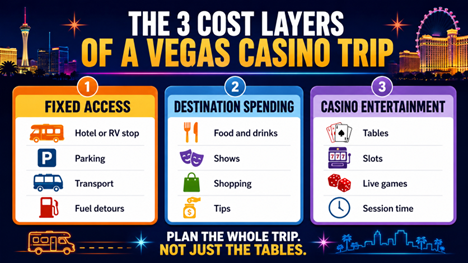
Vegas casino trip cost layers

This Cafe Casino post on what your wallet can expect in Las Vegas serves as an excellent starting point. It puts shows and entertainment at $145 per trip, shopping and miscellaneous spending at $230, hotel and lodging at $465, food and drink at $565, and gambling at $787, with daily averages beside each category. The totals will vary according to traveler, timing, and comfort level, but the pattern is clear, and it makes an excellent foundation for creating a budget.

Where The Vegas Bill Starts

The first pressure point is the stay itself. A hotel price may look clear during the initial search, then change once the traveler adds resort fees, parking, taxes, weekend rates, and distance from where they want to be. A cheaper room can still cost more in patience if every meal, show, or casino visit needs another ride across town.

RV travelers have a different equation. They may not need a hotel room, but they still need to think about where they are stopping, how close the parking is to the action, whether the area feels comfortable after dark, and how much movement the night requires. A Vegas stop can include fuel, time, parking rules, hookups, and city driving friction.

Food is the next consideration. Vegas makes eating part of the trip, especially when the plan includes a show, a late return, or a long resort evening. A traveler who budgets only for casino play may still spend heavily on meals because the setting encourages convenience. Snacks, drinks, casual restaurants, and one nice dinner can reshape the day.

Why Shows and Distance Change the Math

Las Vegas sells time as much as entertainment. A show ticket may look like one purchase, but it can move the whole evening. Dinner happens earlier. A ride may be needed both ways. A traveler may pay more to stay closer, or spend extra time moving between places.

Distance matters because the Strip can make nearby places feel farther than they look on a map. Heat, crowds, road crossings, large properties, and late-night fatigue can turn a short walk into a poor decision. That does not make the trip bad. It means the budget should include comfort choices.

A useful Vegas plan starts with the day type. A casino-first stop might call for simple food, parking settled early, and fewer side activities. A show-first night may need a tighter food plan and more travel cushion. An RV stop may work best when the city visit is short and the base stays predictable.

Build The Trip Around the Real Cost

The cleanest way to plan is to divide the trip into fixed access, destination spending, and casino entertainment. Fixed access includes the room or RV stop, parking, fuel detours, and transportation. Destination spending includes food, drinks, shows, shopping, and tips. Casino entertainment sits in its own space, so it does not blur with every other part of the day.

That separation helps the reader adjust. If lodging is the splurge, food can stay simple. If the casino floor is the main event, settle transport and meals before the night gets crowded. If the RV is the trip base, a shorter visit may feel better than stretching one stop into every version of Vegas.

Vegas feels expensive because the city bundles atmosphere, movement, and comfort into one visit. A traveler who sees those layers early can decide what deserves space in the day. The tables may be the reason for the stop, but the trip works better when surrounding costs have a clear job, which fits PLOS One research on how digital travel tools can guide planning, while leaving room for actual conditions on the ground: tourist app use and travel experience.