
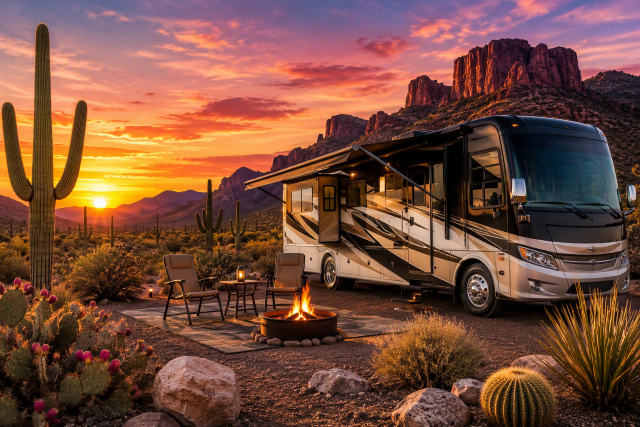
Ask any long-haul RV traveler what changes most when the nearest gaming floor is a four-hour drive away, and the answer usually isn’t the scenery. It’s the money. Out on a quiet stretch of BLM land near Quartzsite, or tucked into a dispersed site outside Moab, the whole rhythm of a casual evening shifts. There’s no cashier’s cage, no player’s club desk, no line at the ATM. Yet plenty of boondockers still want a little light entertainment after the sun drops behind the mesa — and, just as importantly, they want a clean way to move winnings without hauling those winnings anywhere at all. That single need, quiet and location-independent, is where crypto quietly enters the picture.
For travelers who already keep a portion of their spending money in digital coins, the appeal of moving winnings straight back into a wallet is easy to understand. Before settling on where to spend an evening, many of them lean on review sites that vet crypto-friendly gaming destinations, comparing which ones actually pay in Bitcoin and which ones just say they do. A resource that lets someone research where to play with bitcoin deposits does the heavy lifting of sorting the reliable spots from the dodgy ones, flagging coin support, cashout speeds, and the overall reputation of each destination. For a boondocker with one flickering bar of signal, that kind of pre-screening matters more than it would for someone standing in a lobby, because there’s no staff to ask and no counter to walk up to. The review becomes the front desk.
Why the Cashout Matters More Off-Grid
On a physical floor, cashing out is almost an afterthought. You feed a ticket into a machine or hand it to a teller and walk away with bills. Off-grid, none of that exists. A traveler parked in the high desert can’t exactly drive two hours to redeem a slip. So the question becomes how winnings actually leave a digital account and land somewhere useful.
Crypto answers that question neatly. A payout in Bitcoin or a stablecoin lands in the same wallet that holds gas money and grocery money, no bank branch required. That’s the whole draw for people whose home address is a set of wheels. Winnings don’t need to be tied to a fixed mailing location or a local branch that might be states behind them by the time a check would clear.
The Signal Problem, and Working Around It
Boondocking and bandwidth have always been an uneasy pair. Some travelers swear by a cellular booster and a rooftop antenna; others plan their overnight stops around where the maps promise a usable signal. The reason it matters here is simple: a crypto transaction needs only a brief, stable connection to confirm, far less than streaming a movie or hopping on a video call.
That lightweight footprint is part of why coin-based play suits road life. A wallet transfer is a small burst of data, then done. It’s the same efficiency researchers keep exploring in adjacent fields — the U.S. Postal Service has even studied possibilities for blockchain use in delivery and identity systems, precisely because the underlying tech moves value and verification without a heavy central hub. For someone whose “hub” is a fifth-wheel in the middle of nowhere, that decentralization isn’t abstract. It’s the difference between a smooth evening and staring at a spinning loading wheel.
Privacy That Travels
There’s another reason the desert crowd leans this way, and it isn’t secrecy for its own sake. It’s practicality. A traveler who bounces between states over a single season doesn’t want a tangle of location-tied accounts, address confirmations, and paperwork chasing a moving vehicle around the map.
Coin-based transfers keep the footprint light. The same privacy-minded thinking shows up in academic work on mobile users, too — one study on a privacy-preserving scheme for roaming energy trades tackles the very problem of people who move constantly and still need to exchange value securely without broadcasting exactly where they are. Swap “energy” for “leisure spending” and the parallel is striking. Roaming humans have roaming needs, and systems built around a fixed address tend to creak when the address keeps changing.
Planning the Evening Before the Signal Drops
Smart boondockers treat their off-grid evenings the way they treat water and propane: stock up before you need it. That means picking a trustworthy destination while parked somewhere with a decent connection, funding a wallet ahead of time, and knowing exactly how a payout will route back before ever placing a wager.
The habit mirrors how the same crowd handles Vegas trip budgets — mapping fuel, dump stations, and overnight lots in advance so the trip itself runs smooth. A little front-loaded homework turns a shaky one-bar signal into a non-issue, because the account is ready and the cashout path is already understood.
The Quiet Appeal of Distance
There’s something fitting about the whole setup. The travelers drawn to dispersed camping are the ones who value not being tethered — to a hookup, a schedule, or a crowded lot. A payout that follows them into the same wallet, from anywhere with a whisper of signal, fits that ethos perfectly.
So when a boondocker eyes a cashout far from any floor, it isn’t restlessness talking. It’s the same instinct that put them out there in the first place: keep things simple, keep them portable, and never let a fixed location dictate the terms of a good evening.


